Deutsch
 Español
 Français
 Italiano
 Nederlands
 Português
 日本語
日本語 한국어
한국어 简体中文
简体中文 繁體中文
繁體中文
.jpeg)


If you're planning a trip between Tokyo, Kyoto, and Osaka — the three cities most travelers put at the top of their Japan itinerary — the Tokaido Shinkansen is the train you'll be boarding. It's Japan's busiest bullet train line, running along the Pacific coast and linking the country's most visited cities in under three hours. Think of it less as a transport option and more as the backbone of any classic Japan trip.
What makes it special isn't just the speed. It's the reliability (average delays under two minutes per train ), the frequency (trains depart Tokyo every few minutes during peak hours), and the fact that it's fully covered by the JR Pass on Hikari and Kodama services — meaning most travelers can hop on without spending an extra yen.
Table of contents:
What is the Tokaido Shinkansen?
There’s a good chance that you’ve heard about the term Tokaido, when reading about the Japan Rail Pass, browsing our forum or maybe the term Tokaido is completely new to you. Either way, we are here to explain into detail what to Tokaido Shinkansen is.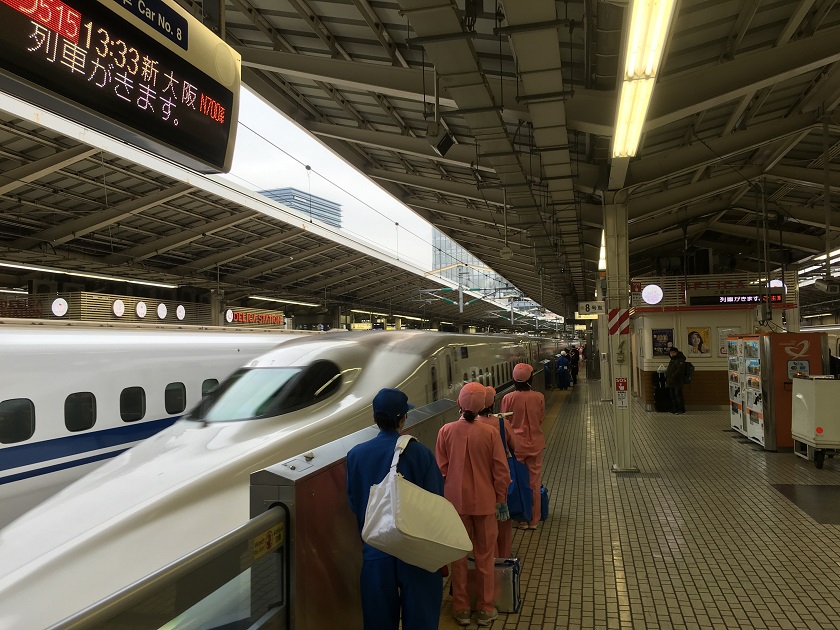
Brief history of the Tokaido
The Tokaido (東海道) has its origins in feudal Japan, where it was the most important trade route connecting Tokyo, Kyoto, and Osaka. The route follows Japan's Pacific coastline — that's also where the name comes from, roughly translating as Eastern Sea Route. There used to be 53 post towns along the route, where travellers could rest for the night, resupply, and trade. Among its travellers was the legendary ukiyo-e master Hiroshige, who painted each of the stations in a famous series of woodblock prints — many of them featuring the unmistakable silhouette of Fuji-san in the background.
In 1964, the Tokaido Shinkansen line opened, just in time for the Tokyo Summer Olympics. It was the first bullet train line in the world, connecting Tokyo to Osaka at 210 km/h (130 mph). Today, trains on the Tokaido Shinkansen reach a maximum operating speed of 285 km/h (177 mph), covering Tokyo to Kyoto in just 139 minutes and Shin-Osaka in around 160 minutes.
Train services on the Tokaido Shinkansen
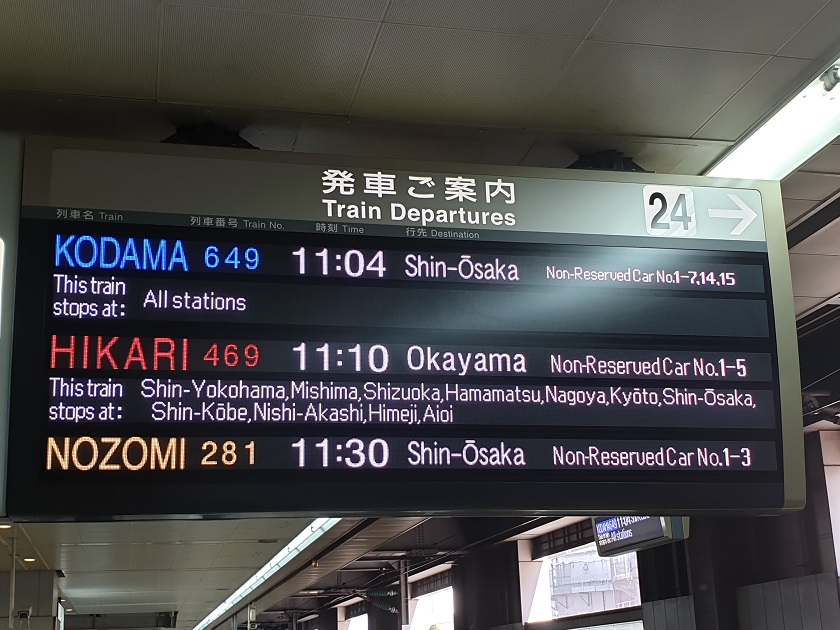
There are three train services on the Tokaido Shinkansen:
Nozomi
The fastest and most frequent service, the Nozomi only stops at the most important stations — Tokyo, Shin-Yokohama, Nagoya, Kyoto, and Shin-Osaka. It's the train most business travellers use, and the one you'll see departing most often from the departures board. The standard JR Pass does not cover the Nozomi; however, JR Pass holders can now purchase a special complementary ticket at station machines or counters to board Nozomi services. Worth considering if you're short on time and a few extra minutes matter.
Hikari
The Hikari runs the same modern trains as the Nozomi but makes a few more stops along the way, including Odawara (your gateway to Hakone), Atami, and Shizuoka. The time difference is often minimal — just around 19–20 extra minutes compared to the Nozomi on a Tokyo–Kyoto run. The Hikari is fully covered by the JR Pass and is the go-to choice for most Pass holders travelling between the main cities.
Kodama
The Kodama stops at every station along the line, making it the right choice when you're heading to a smaller town like Mishima or Kakegawa that the faster services skip. It's also handy as a "last leg" train — many travellers ride a Nozomi or Hikari to a big station, then switch to the Kodama for the final stretch. Note that some Kodama services terminate at Nagoya rather than continuing to Shin-Osaka, so always check your specific departure.
Can I use the JR Pass on the Tokaido Shinkansen?
Yes — the JR Pass is valid on both the Hikari and Kodama services across the entire Tokaido Shinkansen line. For most travellers, the Hikari is the sweet spot: it's covered by the pass, stops at all the key tourist destinations, and the journey between Tokyo and Kyoto takes around 159 minutes — only about 20 minutes longer than the Nozomi.
If you'd prefer to take the faster Nozomi, JR Pass holders can now purchase a special complementary ticket separately, available at ticketing machines and station counters throughout Japan. This lets you upgrade to the Nozomi without paying the full fare — useful if you're catching a tight connection or simply want the quickest option available.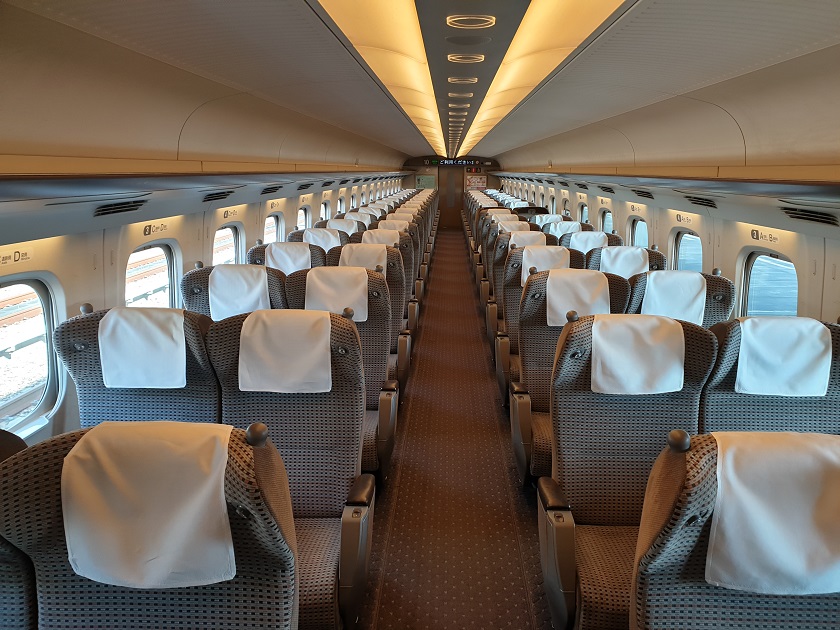
Green Class on the Tokaido Shinkansen
Map of the Tokaido Shinkansen line
The line runs 515 km from Tokyo Station to Shin-Osaka, threading through 17 stations in total. For a full rail map of Japan, see the JR lines map.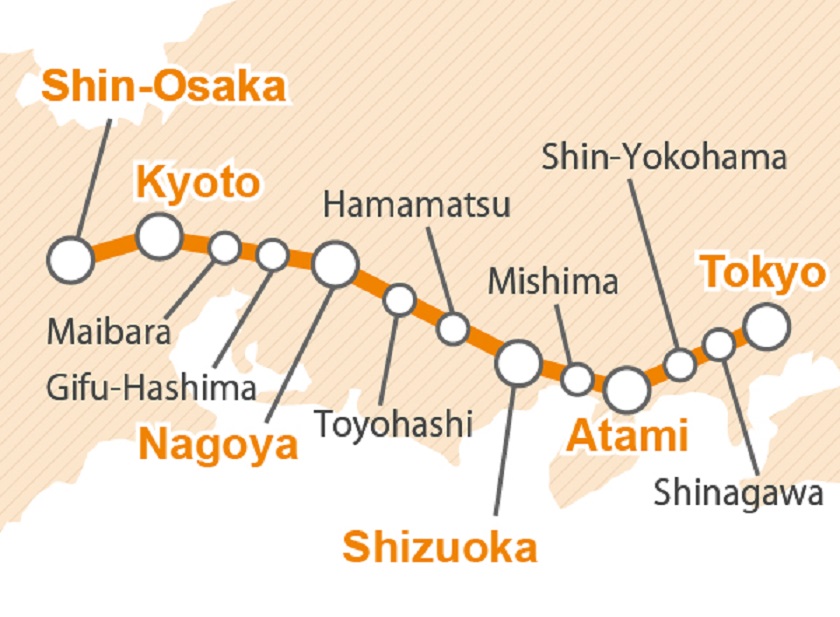
Map with the main stations on the Tokaido Shinkansen
Future of the Tokaido Shinkansen
The Tokaido Shinkansen is in better shape than ever. JR Central completed the rollout of the N700S "Supreme" — the most advanced train in the series — into regular commercial service in 2021. The N700S brings improved active suspension for a smoother ride, enhanced earthquake-response braking, and a higher test ceiling speed of 362 km/h, though the line currently operates at a maximum of 285 km/h. All older Series 700 trains have been retired, meaning every Tokaido Shinkansen you board today is a modern, fully upgraded train.
Looking further ahead, JR Central is developing the Linear Chuo Shinkansen — a maglev line that will eventually connect Tokyo and Osaka at speeds of up to 505 km/h (314 mph), cutting the journey to around 40 minutes. The first phase, linking Tokyo and Nagoya, has been delayed and is now targeted for 2034. Until then, the Tokaido Shinkansen remains the definitive way to travel Japan's most popular corridor.WiFi on the Tokaido Shinkansen
Free WiFi is available on all Tokaido Shinkansen trains. JR Central completed the fleet-wide rollout in 2020, and the service now covers all 131 trains across the entire JR Central Shinkansen network. Look for the "Shinkansen Free Wi-Fi" sticker in each carriage to confirm availability.
In practice, the connection works well for messaging and light browsing, but can be inconsistent at high speeds or through tunnels. If you need a reliable, uninterrupted connection — for video calls or heavy data use — a Pocket WiFi device or a Japan travel eSIM remains the more dependable option.
Sample Trips on the Tokaido Shinkansen
The Tokaido Shinkansen works best when paired with Japan's wider rail network. Here are three itineraries that show it in action:
Trip 1 — Tokyo → Kyoto → Osaka (The Classic Route)
Best for: First-time visitors | Duration: 3–7 days
Board a Hikari at Tokyo Station (covered by JR Pass) and reach Kyoto in around 2h40min. Spend 2–3 days in Kyoto exploring temples and the Arashiyama bamboo grove, then hop back on the Shinkansen for the 15-minute leg to Shin-Osaka. From Osaka, you can extend the trip southward by connecting to the Haruka Limited Express to the Kansai region, or loop back to Tokyo — all covered by the JR Pass.
Trip 2 — Tokyo → Odawara → Kyoto (With a Hakone Detour)
Best for: Nature lovers and Mount Fuji views | Duration: 4–5 days
Take a Hikari from Tokyo to Odawara (approx. 35 min), then switch to the Hakone Tozan Railway to explore the Hakone volcanic area and catch views of Mount Fuji across Lake Ashi. After a night or two in Hakone, return to Odawara Station and board the next Hikari westbound to Kyoto. The total rail time from Odawara to Kyoto is around 80 minutes — an easy continuation of your journey.
Trip 3 — Tokyo → Nagoya → Kyoto → Hiroshima (The Extended West)
Best for: History and culture seekers | Duration: 7–10 days
Start with a Hikari from Tokyo to Nagoya (approx. 100 min, JR Pass covered) to visit Nagoya Castle and the samurai district. Continue to Kyoto, then push further west onto the Sanyo Shinkansen from Shin-Osaka to Hiroshima (approx. 45 min via Hikari or Sakura — both JR Pass covered). From Hiroshima, a short JR ferry connects you to Miyajima Island and its iconic floating torii gate. The entire route — Tokyo to Hiroshima — is seamless on a single JR Pass.
.png)